Showing posts with label 2015/2016. Show all posts

Friday, April 15, 2016

Information Regarding Candidates for Office

This is a summary of our candidate's positions. Voting will take place Tuesday April 19th from 12:20 to 1:00. Polls will close at 1:00. Voting is open to everyone at FAITH except for the nursery/toddler children.


All of the candidates are clearly Pro-life. Jackson St. Onge and Gabe Lacasse are the candidates that have been the most direct in this area and Gabe has indicated specifically that he will defund Planned Parenthood.

On the topic of Terrorism, specifically Isis, all of the candidates are for continuing to fight Isis and terrorism worldwide. Steven Gudek was the candidate that specifically indicated that he felt expanding and strengthening our military was definitely on his agenda. Jackson St. Onge also made a point of stating that he would support increased training of our troops so they would be even more able to be successful in this fight.

Each of the candidates has his own ideas of how to improve our economy. Josh Mitchell clearly feels that budget cuts will be necessary and that a commitment to job creation and growth is key to getting back on track. He indicated that he would make a point of funding small business.
Gabe Lacasse has made it clear that he would be going after the welfare programs in the country and cutting them back severely. It is his intention to encourage all people currently on welfare to begin to seek employment although he does not have a strong platform on job creation. Gabe does have strong feelings about stopping the borrowing of money from China and plans to slow that down and eventually stop this practice.
Stephen Gudek proposes a lower tax rate for everybody. He and the other candidates have also mentioned that they would lower gas prices although they do not agree on the price each one would drop it to. Stephen also supports funding small business but unlike Joshua Mitchell, he would pick and choose which ones he funded and that the criteria for choosing would be how much of a help they were to America.  Joshua Mitchell is the candidate that has indicated most clearly that he will reduce the size of government if elected.
On the topic of immigration, the candidates are split. Josh Mitchell and Gabe Lacasse are for a wall between Mexico and America. Stephen Gudek still flip flops on whether he would or would not support one and Jackson St. Onge has said loud and clear that he does not support a wall as a means to control immigration.

All of the candidates support stricter control of prescription drugs.

In terms of the second amendment Josh Mitchell is the most vocal supporter and Gabe Lacasse certainly supports the right to bear arms and carry concealed weapons. Stephen is definitely against carrying concealed weapons for safety reasons.

All candidates are in favor of teaching Christianity in schools but Gabe Lacasse did indicate that he would support the rights of Americans to choose the religion they wanted to follow.

Finally, Gabe Lacasse has stated several times that he will abolish Obamacare. Stephen Gudek indicated that the environment and the abolishing of the Common Core would also be priorities.

Josh Mitchell has told the American people that he would do whatever he felt would be in the best interests of the people and Jackson St. Onge clearly feels that the poor in America are a group that has been underrepresented and needs defending.

Wednesday, April 13, 2016

Archaeology - Process Review

{assignment listed at end} 

In preparation for next week's archaeology mystery party, the kids reviewed their archaeological vocabulary and techniques.  They were reminded that digging is by nature destructive.  Data can be destroyed every time soil is moved or objects are touched.  Archaeologists attempt to minimize this risk through carefully selecting the right tool for the right conditions, and focusing on slow, methodical work.


In class activities:

  • Brainstormed activities we have done throughout the elective to include in our party
  • Worked on our archaeology notebooks
  • Reviewed the steps in the process of archaeology
  • Learned some new archaeological vocabulary
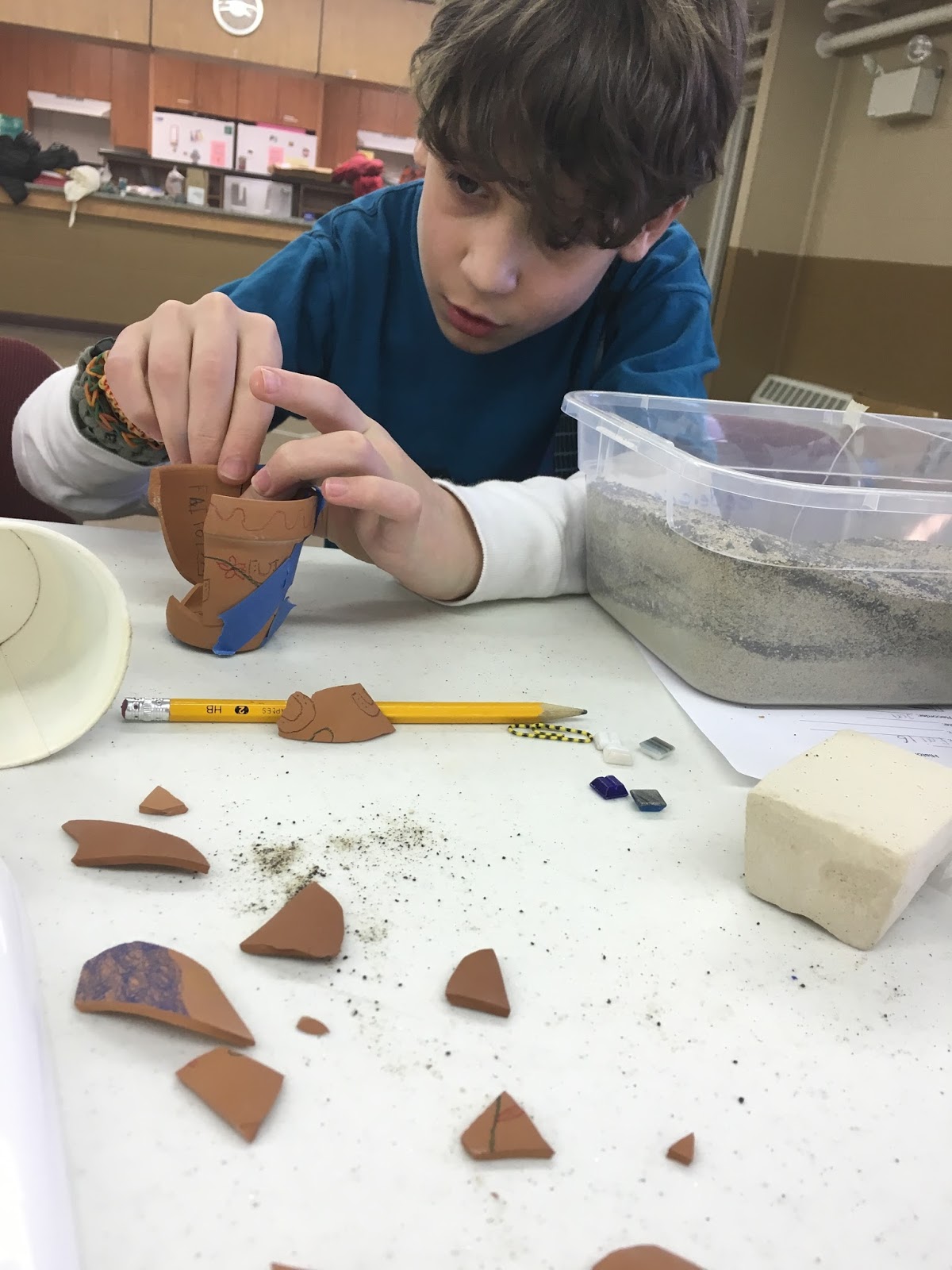
  • Completed reconstruction of our pots
Optional lesson extension activities:
Assignment:
  • Think of one thing that you think that the people of the future would like to know about you.  Find an object that represents this idea and bring it to class to add to your own personal time-capsule. (items will be returned)
Additional notes:
  • Please check your pots, you should have gone home with the one you originally created, not the one you reconstructed.  If your name is not written on the bottom, please bring it back to class with you.
  • We will hopefully be outside again next week, dress appropriately
  • I plan to make a cake to share with the students during our party.  If there are any dietary concerns, please let me know.
Special thanks: Parents, please let your children know how much I appreciate their kindness to one another.  We had no TAs available during our project this week, and all 25 of the kids pitched in to help with hot glue guns, pot re-assembly, and clean-up beautifully.  I am so proud of them!

Tuesday, April 5, 2016

Archaeology - Pompeii

{Assignment for next week listed at end}

Pompeii was one of the first archaeology sites.  It was first discovered in 1549 while digging for a water channel, after having been buried in ash since 79AD. The site was later pillaged for works of art by the king of Spain.  Excavations have continued growing deeper and more careful over time.  Current archaeological work at Pompeii is focused on layers beneath the time of the catastrophic eruption.


In class activities:

  • Learned about excavations at Pompeii
  • Discussed changes in the field of archaeology over the past 300 years
  • Continued work on our mock dig site using sifters
  • Documented discarded artifacts
  • Worked to re-assemble pottery sherds
  • Discussed the necessity for archaeologists to work together (one piece from each student's pot was placed in a different student's box, along with several pots that were spread throughout the entire class)
Optional lesson extension activities:

Assignment:
  • We will be outdoors next week.  Please wear appropriate shoes and bring a jacket to class.
  • Students will continue restoring their pots next week.  Extra hot-glue guns would be appreciated!
  • Take a look at the archaeology field trip details, and let me know if you plan to attend.  


Monday, April 4, 2016

Archaeology Field Trips

Hi friends!  

The archaeology class is planning a field trip to the UNH Open Archaeology Day to view a series of hands-on activities, including stone tool knapping (or flaking), mock excavation, ancient foodway sampling, and atlatl (spear) throwing.  I hope your family will be able to join us!


Friday April 22nd, 2016
1:00 - 4:00
Huddleston Hall Room G16, 73 Main Street, Durham NH. 
e-mail Sheryl if interested in attending
metting location & lunch details to follow


This event is technically only open to college students, so you MUST register.  Please let me know exactly how many members of your family are attending by 4/11.

Additional Events: Did you know that April is Archaeology Month here in NH?  There are many events that are open to the public.  Take a look at the full schedule!

I am going to be attending several events including the dig in Deerfield on 4/14 and the Pompeii presentation on 4/16 with my kids, so if you find one that interests you, pop me an e-mail and we can try to meet up while there!


Friday, April 1, 2016

March 29th, 2016
The younger Art Class
We have been working on our creation book. Each week, adding another watercolor. We have been mixing colors, learning watercolor techniques, and drawing.

Wednesday, March 30, 2016

Archaeology - Rosetta Stone

Before the discovery of the Rosetta Stone, Ancient Egyptian (both hieroglyphic and demotic) writing was a mystery to historians.  The stone was carved in 196 BC, but was torn down and used as a building block for years until its discovery by French soldiers in 1799.  Over the next hundred years, many different people worked to decode the writing on the Rosetta Stone.  Jean-François Champollion is credited with finally discovering the connection between Coptic and the ancient writings, thereby making Egyptian writing understandable to modern scholars.

In class activities:

  • Watched portions of Ancient Mysteries of the Rosetta Stone
  • Discussed how not all archaeological discoveries are made by archaeologists
  • Reviewed the difference between pictographs and phonetic writing
  • Learned about the importance of ancient writings to understanding history
  • Excavated multiple layers in our dig site
  • Compared our discoveries to existing documents to try to decode the meaning of a tablet we discovered
  • Documented results
Optional lesson extension activities:
  • Finish watching Ancient Mysteries of the Rosetta Stone
  • Type up several phrases in a simple hieroglyph translator, and see if you can come up with a complete alphabet (without typing the alphabet letter for letter).  Notice how several sounds are represented by one symbol, and several symbols can be used for a single sound.  How would this impact translation attempts?
  • Make a list of all the archaeological tools and systems you have learned.  Try to write an instruction manual for future students.  
Assignment:
  • We will be working on artifact restoration next week.  If anyone has a hot glue gun, please bring it with you!  

Tuesday, March 29, 2016

History Elective Pathfinders and Navigators 3/29/2016

The media presented the summaries of the candidate’s positions. The different media people uniquely summarized the position of each candidate with respect to the issues discussed in the previous debates. They were all well done.

The class then split into two groups. They were given the exercise of creating a new government. They had to come up with; 1. Ideas that their government would be based on and 2. How those ideas would put be into practice within their new government.       

The assignment for each of the students in the group is to go home and take the material from their group and fill in any holes that remain. Next week your group will explain to the class what your government stands for and how they will put those things into practice.                                            

Tuesday, March 22, 2016

Archaeology - Terra Cotta Warriors

The first emperor of China, Qin (Chin) Shi Huang Di, wanted to live forever, and take his army with him.  Rather than kill all of his officers upon his death, as previous leaders had done in his area, he decided to build a massive life size army out of clay.  Each soldier was crafted differently, and placed by rank with the appropriate arms and supplies.

This massive army was unknown until a farmer, working near the known grave of Emperor Qin Shi Huang Di, attempted to dig a well, and accidentally discovered the ancient pottery.

In class activities:

  • Learned about religion during the warring states period
  • Discussed the major advances made by Emperor Qin Shi Huang Di
  • Discussed the impact of replacing killing soldiers with building clay soldiers
  • Looked at images of terra cotta soldiers and hypothesized about the many missing weapons
  • Read portions of an archaeological field manual
  • Learned how to properly label both clay and other items
  • Worked on our own dig sites, uncovering pottery and intrusive items
  • Documented our finds
Optional lesson extension activities:

History Elective Navigators & Pathfinders March 22, 2016

Today the class listened to various media reports from last weeks debates. We then watched the video Learn Our History - Election day - Choosing our President.  Pastor Huntley briefly discussed the some of the things brought up in the video and we briefly looked at the differences in the Democratic Party's stance on certain issues then and how much they have changed today.

Next Tuesday, the 29th, each candidate will have 30 seconds to present their position statement. They should be writing a document to pass out that outlines their position on the following: guns, the economy, jobs, marriage and right to life. These are mandatory. You may also include immigration, healthcare including the drug epidemic and the first amendment.

The media people are expected to summarize what each candidate has said about their positions on the topics presented in all of the debates so far.

Wednesday, March 16, 2016

Archaeology - Mt Lassois Fort & Vix Grave

Mont Lassois is a Celtic hill fort from the late Iron Age in Britain (approx. 520 BC) consisting of several large banks of earth protecting a settlement at the top of the hill.  The discovery of archaeological material in the area of Mont Lassois began in April 1930 by amateur treasure seekers. Progressively systematic work over the following years revealed a variety of both small finds, and large building remnants including post houses, pit dwellings, hearths and storage areas.


The nearby Vix burial mound was excavated in early 1953 by René Jouffroi. He discovered the untouched grave of a woman wearing a crown.  Her tomb contained many valuable items including a chariot and an enormous metal krater (wine urn) which was obviously made in Greece, indicating trade between the two areas.

In class activities:
  • Learned about hill forts and discussed the advantages that height provides
  • Looked at images of archaeological sites, paying attention to how changes in soil color and compaction can indicate buildings
  • Noted the Lady of Vix's crown and discussed the changes in social heirarchy that happened as people settled together
  • Discussed how trade impacts the items that archaeologists find
  • Learned about Sir Mortimer Wheeler and the Wheeler method of a grid system for systematically digging while preserving a nearby vertical cross-section of undisturbed strata.  We compared this to the way that layers can be seen when the kids dig straight down while playing Minecraft.
  • Excavated our indoor dig-site and documented the discovery of gems.
Optional lesson extension activities:
  • Learn how archaeologists use geometry as they set up their grid squares: https://www.youtube.com/watch?v=xNdFDzQzqPk
  • Try using your archaeological knowledge in Minecraft!  Create a new world in creative mode, and dig a test pit following all the rules you have learned.  Make sure to leave a section so that you can see the strata.  Pull out the archaeologist's favorite tool, a pencil, and draw the layers that you see.  Make a hypothesis about whether the layers will be the same if you dig another pit several blocks away.  Dig the second pit.  What did you discover?


Tuesday, March 8, 2016

Archaeology - Tutankhamun

British archaeologist Howard Carter discovered the Tomb of Tutankhamun in 1922 in the Valley of The Kings, Thebes, Egypt.  The tomb had remained virtually undisturbed for over 3000 years.  The intact setting allowed archaeologists to not only view priceless treasures and significant artifacts, but to examine the mummy in its multiple coffins.  Modern scientific research is still being conducted on this remarkable find today.


In class activities:
  • Learned about Howard Carter's profession as an archaeological artist
  • Discussed Edwardian society, and how Lord Carnarvon was a necessary funding source for the excavation of King Tut's tomb
  • Discussed clustering and how the Valley of the Kings pervious tombs gave archaeologists clues about where to dig for future discoveries
  • Conducted a playground sweep.  Searched for topical clues (milk jug "stone blocks" and different colored sand) that would indicate where we would most likely find artifacts.  Excavated and documented our finds.
Optional lesson extension activities:

History Elective First Period March 8, 2016

Over the past few weeks, the history elective with Pastor Huntley has turned into a real live race for the presidency! During the classes Mr. Huntley has taught, in detail, the aspects of what happens during an election year. Topics covered have been addressed in terms of what they are and why they are important. The steps a candidate takes before he announces that he is running and the subsequent campaign, primary elections, the general election, the Iowa Caucus and super Tuesday have been covered thus far.

The practical part of the class has included the four presidential candidates and their campaign managers studying up on the issues important to the current campaign. Issues that have been debated range from Terrorism (ISIS specifically), illegal immigration, Planned Parenthood funding, the national debt, job growth, Second Ammendment rights and the economy.

Each class begins with our various media reporters playing or reading their report on the previous week's debate. We have television, radio and written reports and they have done a great job. Then the candidates are put on the spot to answer questions from the media on whatever topic the media chooses. They are kept on their toes but they are all doing super!

Today, after the debate, Mr. Huntley took a part of the class to teach the students about the economy, specifically how cutting taxes and regulations on business actually produces wealth.

A guest parent, Selectman LaCasse, had previously asked the candidates what they thought of the federal reserve printing more money. He graciously explained to the students the history of the Federal Reserve's printing of our currency, how our dollar previously was valued by the backing of gold and silver as well as the changes in this in recent years. He explained how the influx of more printed money into our economy drives the value of our dollar down and how this will affect the retirees and older population's savings.

Thursday, March 3, 2016

March 1, Art-Younger group: The last two weeks of class we:
-Did some drawing exercises from "Drawing with Children"
-Talked about silence being helpful in the creative process
-Learned how to prepare a watercolor wet on wet paper
-began our books on the days of creation by creating the first four pages
     The watercolor techniques we used: preparing the paper by wetting it and "stretching" it, layering colors to create a desired look, using a clean, dry brush to separate two colors of paint, dry-brushing to make a desired effect.
-Did some more drawing exercises from "Drawing Textbook" McIntyre.

Monday, February 8, 2016

Art-Younger class
We looked at children's books that we love and read a story by Jan Brett. Then we talked about why we like these stories. We began to organize a story by creating a story board. We talked about their ideas for a story from what we have been studying for history.  The children did some drawings on it. Their was not a strong feeling from all of them that they grasped what we were going to attempt doing. A couple kids understood, but seemed overwhelmed. There was also expressed that they could not do more work on them at home each week. So, in the interest of not letting them get too discouraged, I have changed our plan; each week I will prepare a specific picture for them to do and give them a specific new skill that we will work on in class. For the rest of the class we did some blending with our Gouache paint.

History Elective First Period February 2, 2016

The class discussed the steps that a candidate takes when they are considering a run for the presidency.
1.       Announce the desire to run for office
2.       See if they will be able to get support. The states of Iowa, New Hampshire and South Carolina would be especially important to get as they vote first in the primary elections.
3.       Once support is assured, financial donations must be sought. These can come from several places;
a.       The candidate’s personal funds
b.       Outside donations
                                                               i.      Small amounts from “ordinary people”
                                                             ii.      Large amounts from “big donors”
4.       Announce official candidacy and assemble their team.
5.       Begin the physical campaign
a.       Create/state the platform they are running on. A platform is the candidate’s own opinions on where he or she stands on foreign and domestic issues.
b.       Enter and participate in debates with other candidates
c.       Travel the country to meet people and get their message out so that the voters will get to know them and what they stand for. This is where the people can ask questions of each candidate.
The Iowa Caucus is the event where representatives of each candidate meet in groups to try and persuade voters to vote for their candidate.
The NH Primary election is where registered voters in NH go to the polls in their community and vote. They have to vote within the party that they are registered for.
The Role of the Media
The media is supposed to report on each of the candidates and their platforms. Reporting is supposed to be fair, neutral and balanced. Editorials are the places within the paper where the writers can air their opinions.

Ads and book covers from various candidates and papers were reviewed for ideas on how candidates and the media could report on each campaign.

The roles of each student for the presidential campaign were decided upon.

Wednesday, February 3, 2016

Archaeology - Stonehenge

Archaeology is the study of our past through systematic recovery and study of material items.  These items are often found through a complex process of digging.  In order to stay on top of everything that is going on, and to help ensure that a minimal number of subtle clues are missed, archaeologists take voluminous notes.  When they need to later write a report or examine data, their journal becomes an important tool.  

Stonehenge is the first archaeological site we studied.  It was built in the late Stone Age during the Neolithic period.  Because this site is part of pre-history (before our written records begin) we know very little about why it was built, but the excavation of cremated bones of adult men within the site has led archaeologists to question whether it was a burial site for respected leaders.  


In class activities:
  • defined the word archaeology and discussed what the job of an archaeologist is
  • learned about the most recent excavations of Stonehenge
  • viewed images of Stonehenge & discussed the late stone age/early bronze age
  • learned that druids were not the builders of Stonehenge
  • set up our own field notes (journals)
  • drew our first dig site grid, labeled locations of finds, and cardinal directions
  • It was beautiful outside, so we ran around the building playing a cardinal directions game 
  • learned about the importance of context & observations in archaeology


Lesson extension activities:

These are great sites, and your child may enjoy checking them weekly for new information.

  • ArchNet: index of quality archaeological sites. Check the "new and uncategorized" section for recent additions

  • Anthropology in the News: The latest finds, discoveries, and controversies. Updated frequently. Great for getting the real story behind a vague facebook posting.
Stonehenge activities

Suggestions for older students:

  • I will not assign any writing, but I highly recommend that older students write at least one paper during the course of this term.  The sites listed above offer plenty of inspiration and resources for research.
  • The following two mysteries offer a humorous way to study the academics of archaeology.  Though not true stories or set in ancient times, they have been recommended to me because of their approachability.  Note: I HAVE NOT pre-read these books, but will be going through the first one with my children during the semester, and will notify you if I find anything inappropriate for young children.   UPDATE: These books contain some inappropriate language and innuendo.  Due to that and the dense vocabulary, I would not assign them to anyone younger than high-school.  However, I found that I was able to quickly edit anything inappropriate during our read-aloud time, so if you are interested in working through the books together these may be a good fit for your family.

Assignment:
  • Bring one measuring implement to class, and begin thinking about why this is one of the most important tools in the field.  Archaeologists are famous for their use of metal tape measures, but any ruler do.  The kids will be leaving these in their dig-kits for the next few weeks, so please label it appropriately.  I want to make sure everyone's items make it home.
Parents - This class is much larger than I originally expected.  In order to keep our projects fun and hands-on, I'm going to need some help with clean up.  If you are available for 5-10 minutes after class to either sweep or fold tables & chairs, please let me know.

Update 2/8/16: I was just looking at the March/April copy of British Archaeology (yeah, I know it is only the beginning of February, but magazines hate to look outdated) and they shared information about new finds that contradict what I spoke to your kids about in class.  There were, in fact, several women found among the cremated remains in Stonehenge, which will change how the data about this society is interpreted.  As always, history is constantly being revealed!  

Wednesday, January 27, 2016

Summaries for Explorers and Trailblazers: Last two weeks of first semester: Both classes worked on drawings the week before last. They were considering entering the HSLDA contest.
 This week, only the Trailblazers continued in this endeavor. We experimented in making beautiful skies with watercolor. They all did wonderfully!
The Pathfinders saw pictures of all types of Ancient Jewelry. Then they created their own bobbles to be strung into a piece of jewelry. If you are lucky and they follow through, you will receive a lovely piece of art for Valentines day!

Tuesday, January 26, 2016

Split of Rome - History 1&2, Explorers & Trailblazers

By 285 CE the Roman Empirehad grown so large that it was unable to govern all the provinces from Rome. The Emperor Diocletian divided the empire into halves with two emperors who would work together but rule separately. The Eastern Empire was governed out of Byzantium and the Western Empire from Rome.

On June 19, 325 Constantine, the first Christian Emperor of Western Rome, summoned church leaders from around the world to his home in Nicea. His goal was to resolve a growing conflict among religious leaders that threatened civil war in his empire. The two halves of the empire continued to prosper equally until the reign of the Emperor Theodosius I (379 – 395 CE).

In class activities:
  • Played a game in which we tried to protect our property from invaders when it was kept in a small area vs. large, and discussed the similarity with Rome 
  • Learned about the split of the Roman Empire
  • Discussed constantine and the 1st Council of Nicea 
  • Made cross bookmarks
  • Reviewed the events that we have covered over the course of the year
  • Completed our Ancient History Notebooks
Optional lesson extension activities:

Next week the kids will begin their electives.  I have truly enjoyed teaching this crew and appreciate their thoughtful questions and spirit of cooperation in class.  Each child created a notebook during our class.  I encourage you to sit with your child and flip through their work as a review activity (and just for fun).   Please keep this in a safe place. During our year-end program the children are invited to bring in examples of their work to display.

Tuesday, January 19, 2016

Pompeii - History 1&2 Explorers and Trailblazers

The eruption of Vesuvius in AD/CE 79 destroyed the Roman city of Pompeii.  In 24 hours the city was buried in seven and a half feet of volcanic ash, and over time this increased to over 30 feet.  It remained buried and forgotten for almost 1700 years. We  learn about Pompeii today from the words of 18 year old Pliny the Younger and from archaeological discoveries.

In class activities:
  • Created a chart about Pompeii including our current knowledge, our questions, and what we learned in class
  • Read 1st person account the final hours of Pompeii written by Pliny the Younger
  • Created chalk pastel images of volcanic ash
  • Learned about how archeologists filled voids in the ash to create casts
  • Several children mentioned having visited a MOS exhibit on Pompeii and shared about what they learned
  • Discussed how the excavation of Pompeii gives us insight into the lives of Romans
Optional lesson extension activities:
  • View images the casts from Pompeii and learn about their restoration (warning for sensitive children: these are actual artifacts, so some skeletal remains are visible)
  • Enjoy several online activities at Mr. Donn
  • Watch a detailed video of Pompeii's final day.  Historical fiction.  Please pre-view, this may not be suitable for all children.
Assignment:
  • Read history cards NT 29-31 (these are the final cards we will cover before electives.  Save card 32 for next year)
  • Practice your timeline

Wednesday, January 13, 2016

Persecution of Christians - History 1&2, Explorers and Trailblazers

Romans tolerated Christians, for a while, as worshipers of just one more among the long list of gods.  Eventually, however, Christians’ insistence on following Jesus alone made both religious and political leaders feel threatened.  One Roman Emperor, Nero, unjustly blamed the Christians for starting a fire that destroyed nearly 2/3 of the city of Rome in 64AD/CE.  He ordered that many be put to death.  One form of persecution took place in large stadiums such as the Colosseum where citizens gathered to watch vicious battles.  This type of persecution continued until 312 AD/CE.  

In class activities:
  • Viewed our stop motion animation of the life of Jesus
  • Learned who was allowed to wear a toga
  • Played a game placing ourselves in the social classes in Rome, and found where we would sit in the colosseum. 
  • Reviewed the meaning of the word Persecution & learned reasons why the Christians threatened Rome
  • Briefly discussed persecution in our time and prayed for Christians around the world
Optional lesson extension activities
Assignment:
  • Read history card #NT28
  • Practice your timeline